

The DOT physical (required for a Commercial Driver’s License) includes a hearing test. In theory, this hearing requirement helps make sure that truck drivers can hear nearby horns and sirens. In practice, many deaf drivers have proven themselves safe and qualified, and they deserve reasonable accommodations. Over the years, the FMCSA has granted exemptions to hundreds of deaf truck drivers, but the agency hasn’t been very transparent about its decision-making process.
In September of 2023, a federal jury in Omaha sided against Werner Enterprises for refusing to hire a deaf driver who couldn’t complete their training program. The jury awarded the driver more than $36 million. Ironically, Werner Enterprises had won a similar case in the same court a couple of months earlier. What’s the story behind these hearing-impaired drivers? What types of accommodations are causing friction between deaf drivers and trucking companies?
History of Deaf Truck Drivers
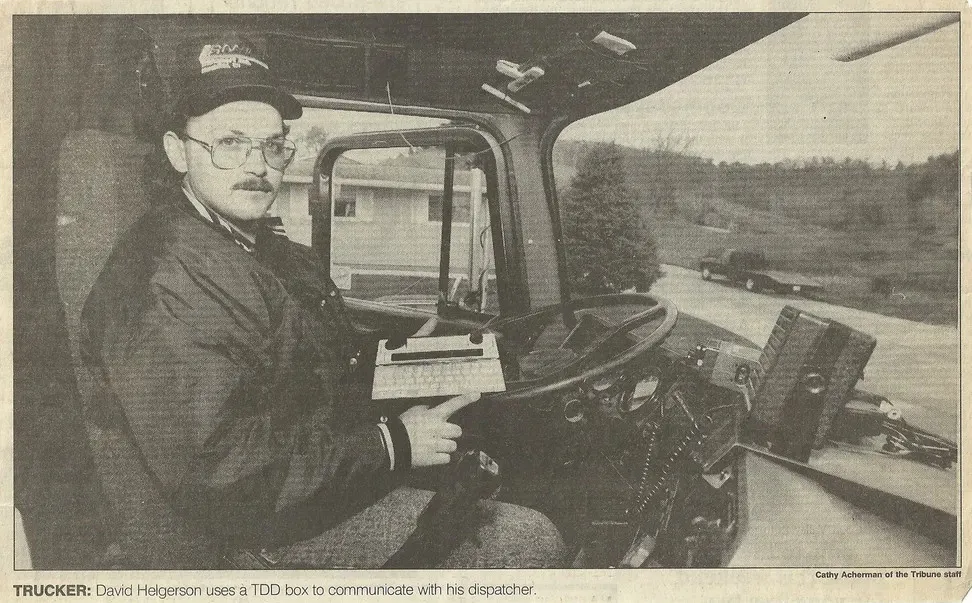
Deaf truck drivers have been on the road longer than you might think. Deaf Truckers United collected stories about drivers like David Helgerson who became licensed at the state level in 1992. The National Association for the Deaf petitioned the FMCSA to remove the hearing requirements for CDL holders. Instead of removing the requirement, the FMCSA started granting exemptions in 2013. It’s an awkward process because drivers must renew every two years, and they might have to wait a full year before getting their first exemption.
So far, exemptions have been granted and renewed on a case-by-case basis. The Commercial Vehicle Training Association (CVTA) has asked for more transparency on how those judgments are made. The FMCSA has reiterated two points from a 2008 report:
- No studies of CDL drivers have yet demonstrated a relationship between hearing loss and crash risk.
- Studies of drivers with hearing impairments (in their personal non-commercial vehicles) don’t show an increased risk for crashes.
It makes sense that the biggest dangers come from drivers who are impaired, fatigued, distracted, or having a medical emergency. Compared to the average driver, a highly alert deaf driver can be more careful about watching their mirrors. Even drivers with great hearing may not notice car horns or sirens, depending on the engine noise, music, and other variables.
Challenges and Success Stories
In 2020, an article in Overdrive Online featured multiple deaf drivers. Autumn Daniel, an ASL interpreter and CDL instructor argued, “Your hearing is just not as important as your other senses in a truck, especially with cellular devices, Qualcomms and other technology.” Warning lights and steering wheel vibrations can replace audible alarms. With or without hearing issues, today’s drivers have a surplus of helpful but fallible technology. From backup sensors to GPS navigation, sometimes the challenge becomes tuning out the noise.
Sandy Sloat was born deaf and always wanted to drive big rigs. When hearing exemptions became possible in 2013, Sloat quit her job welding with heavy-duty equipment in Alaska and moved to Texas for CDL training. “I’ll see it before you hear it,” Sloat said. “I’ve seen distracted hearing truckers run through red lights. I feel like as a deaf trucker, I’m way too alert to do that.”
Richard Boehrer was named Driver of the Year in 2022 by the Truckload Carriers Association. Boehrer was born hearing impaired, but he has driven over a million miles in ten years as a truck driver. He communicates with his dispatcher by text and video, and uses a spray bottle to detect and locate air leaks — a technique that’s also pretty common among drivers without hearing problems. While some accommodations are necessary, it’s clear that some hearing-impaired drivers are exceptionally well qualified and motivated.
Watch “2022 TCA Driver of the Year | Richard Boehrer” on YouTube (opens in a new tab)
What Happened with Werner Enterprises?
The two recent court cases against Werner Enterprises both involve deaf truck drivers, but the different circumstances can help explain the opposite outcomes. In the case that got more attention, Victor Robinson applied for a job at Werner in January 2016. Although Robinson, a deaf man, did not have prior over-the-road experience, he had completed his CDL training at Roadmaster, a Werner-owned driver training center. Reportedly, Werner has been willing to hire deaf drivers with at least six months of prior OTR experience. The controversy centered around Werner’s “placement driver” program, where a new driver must communicate verbally with a trainer. The case made headlines because the jury awarded $36 million in punitive damages to Robinson. The EEOC limit on punitive damages is $300,000.
Another deaf driver found the same federal court less sympathetic. Andrew Deuschle applied for a co-driver position at Werner in 2015. (He had previously applied with Werner in 2014.) In 2015, Deuschle emailed a recruiter about his hearing exemption and said that he had nearly five months of experience driving for C.R. England. Werner “preapproved” his application but ultimately didn’t hire him. A different Omaha jury sided with Werner in July of 2023.
Although Werner’s stance was similar in both cases—neither deaf driver had 6 months of prior OTR experience—there were big differences in the circumstances. Deuschle failed to provide key paperwork to Werner, including proof of his exemption. Where Deuschle received a potentially misleading “pre-approval” notice, Robinson was allowed to complete an expensive CDL training program.
What’s the Takeaway for Employers?
In January of 2023, the EEOC released an updated set of guidelines for hiring and accommodating deaf workers. In the trucking industry, it’s reasonable to ask deaf drivers for proof of their exemption. For their part, employers need to be ready to make reasonable accommodations. Sign-language interpreters can be accessed by a video relay service. Several types of software convert spoken audio to text. Written memos, notes, and text messages can suffice in many circumstances. Some deaf drivers work effectively alongside their spouse or another team driver without hearing problems.
Trucking companies and recruiters need to be careful about how they respond to deaf drivers who meet all job requirements. It’s great that employers are concerned about the safety of their drivers and others on the road, but deaf drivers can be just as safe and competent as other motorists.
More Resources
- Deaf Truckers United (opens in a new tab) — founded March 4, 2011
- National Association of the Deaf: Commercial Driver’s Licenses (opens in a new tab)
- AAMVA: “CDL Testing for Hearing Impaired Applicants” (2013) (opens in a new tab)
- Riddle, Lyn. “Deaf Truck Driver’s Roadblock is a Federal Rule.” The New York Times (opens in a new tab), Nov. 6, 1988
- Savala, Nez; Young-Bates, Lysa; Dulle, Rene. “Driving Past the Naysayers.” Community College Daily (opens in a new tab), Feb. 6, 2020
- Ronallo, Alex. “Deaf Woman Becomes First in Wisconsin with a CDL.” FOX 11 News (opens in a new tab), Sept. 30, 2016
- Magner, Carolyn. “The CDL’s Open Door for Deaf Drivers.” Overdrive Online (opens in a new tab), Mar. 30, 2020
- Dejka, Joe. “Werner Officials ‘Disappointed’ with $36 Million Discrimination Award to Deaf Trucker.” Omaha World-Herald (opens in a new tab), Sept. 5, 2023
- Pilger, Lori. “Jury Rules in Favor of Werner Enterprises in EEOC Case Over Policy Regarding Deaf Driver.” Omaha World-Herald (opens in a new tab), Jun. 13, 2023